
As a board-certified orthopaedic surgeon, Dr. Steven F. Harwin is renowned for his experience, skill, and accomplishments in the arenas of joint replacement, reconstruction, and arthroscopic surgery. Dr. Harwin serves the New York area through his office on Park Avenue in Manhattan. Dr. Harwin utilizes the most up-to-date procedures, techniques and state-of-the-art materials available in order to meet the range of your orthopaedic and hip replacement needs, including the direct anterior approach and the direct anterior-lateral approach.
Hip Replacement Surgery For Arthritis
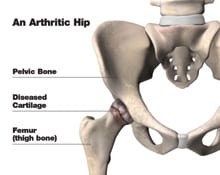
Over the course of a lifetime, “wear and tear” damage to hip joints can add up – contributing to the development of arthritis, hip pain, and sometimes leading to total hip replacement surgery. Although it is an involved process to replace a joint as important as the hip, joint replacement surgery is often the first step in patient recovery, allowing a return to a full active lifestyle.
Hip replacement surgery may be the best option for patients with advanced arthritis that has severely limited the range of motion of the hip joint. The hip joint bears the weight of the entire body and is instrumental in activities as commonplace as standing, walking or even sitting up in bed, so this can affect every facet of daily life for the patient.
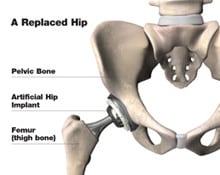
The hip joint is made up of two main parts: the femoral head and the acetabulum. The femoral head sits at the end of the femur, or thighbone, while the acetabulum is the socket in the hipbone into which the femoral head fits to form the hip joint. During hip replacement surgery, the damaged femoral head is removed and replaced with an artificial metal or ceramic ball, while the acetabulum is fitted with a metal or ceramic cup. These two implants work in conjunction to replicate the original hip joint in form and function.
Hip Replacement Surgery’s Medical Innovations
Dr. Harwin utilizes the latest advancements in hip replacement implants and technology, including the use of titanium, cobalt chrome and ceramic implants, highly crosslinked polyethylene, as well as specially treated metal bearing surfaces. Dr. Harwin has performed more than 3,000 hip replacements, including total hip, partial hip and hip resurfacing procedures. He is a designer of total joint implant systems that have been implanted in more than 3 million patients world-wide.
Dr. Harwin is also an expert minimally and less invasive surgery. Most of Dr. Harwin’s joint replacements are performed under a local anesthetic using incisions from 4-6 inches as opposed to traditional surgery of 12 or more inches. This allows him to perform surgery with full visualization to assure proper positioning of components and to reduce complications. Dr. Harwin will discuss his extensive experience with the less invasive Direct Approaches to the hip joint, including the Direct Anterior Approach (DAA) and the Direct Lateral Approach (DLA).
Minimally Invasive Hip Replacement Surgery
Beginning with improvements to surgical instruments, technology and techniques in the 1980s, nearly every type of surgery has benefitted from advancements in minimally invasive surgery. The average size of incisions has been drastically reduced by minimally invasive techniques, and specialized equipment and techniques have allowed surgeons to limit damage to surrounding areas during joint replacement surgery, as evidenced in the direct anterior approach to hip replacement.
Direct Anterior and Direct Anterior-Lateral for Hip Replacement
The direct anterior approach and the direct anterior-lateral are a minimally invasive surgical techniques that minimizes the impact of surgery on the areas surrounding the hip joint. During an anterior hip replacement procedure, the hip joint is accessed through a small incision on the front or side of the patient, directly adjacent the joint itself. Traditional hip replacement procedures require a 12-inch incision that is usually made on the back of the patient. The anterior approach allows surgeons to isolate the area around the joint and reduce the overall impact of the procedure. Dr. Harwin will talk with you about whether you are a candidate for this type of approach.
Benefits of Anterior Hip Replacement:
- Smaller incision
- Shorter recovery time
- Less disturbance of muscles and tendons
- Quicker rehabilitation
- Less scarring
- Reduced risk of dislocation
Revision Total Hip Replacement
Dr. Harwin is also skilled in performing revision total hip surgery for the correction of joint replacements that failed due to various reasons, including loosening, malposition, instability or infection. Failed hip resurfacing and metal-on-metal implants can also be corrected.
Bloodless Total Hip Replacement Surgery
Because of Dr. Harwin’s less invasive techniques and surgical skill, he performs 95% of all primary joint replacements without the need for blood transfusions, and operates on many Jehovah’s Witnesses.
Instructions After Total Hip Replacement
To the Physical Therapist: Dr. Harwin uses a stable anterior approach to the hip, needing few precautions. He encourages return to normal activities as soon as possible. If the patient had a special situation requiring additional instructions, they will have been given specific instructions. Here are the instructions for his patients who have had a routine hip replacement:
- Try to resume a normal walking pattern as soon as you can.
- Put as much weight on the leg as you feel possible.
- Use forearm crutches if possible, rather than a walker.
- Switch to a cane as soon as you are comfortable and secure.
- You may go outside and resume normal activities as soon as you are able.
- Place a soft pillow between the legs for sleeping. With a pillow between the legs, you may sleep on either side.
- Avoid sitting in very low chairs; use of an elevated chair or toilet seat is for your comfort only.
For any questions or clarifications, call Dr. Harwin’s Office.
New York’s Trusted Choice for Hip Replacement
Board certified orthopaedic surgeon Dr. Steven F. Harwin has earned the titles of “New York Super Doctor,” “Top Doctor in the New York Metro Area” and “Best Doctor in America” through his lifelong dedication to excellence in orthopaedic surgery. Find out more about Dr. Harwin and how to make an appointment at his New York City office.
After years of experience and thousands of successful total hip replacements, Dr. Harwin is your best choice for total hip replacement surgery within the New York area.
